
AITO Wenjie M7 Export Guide for Dealers and Fleet Buyers
Plan an AITO Wenjie M7 purchase from China with clear guidance on trims, powertrains, export pricing, MOQ, shipping, homologation and after-sales support.
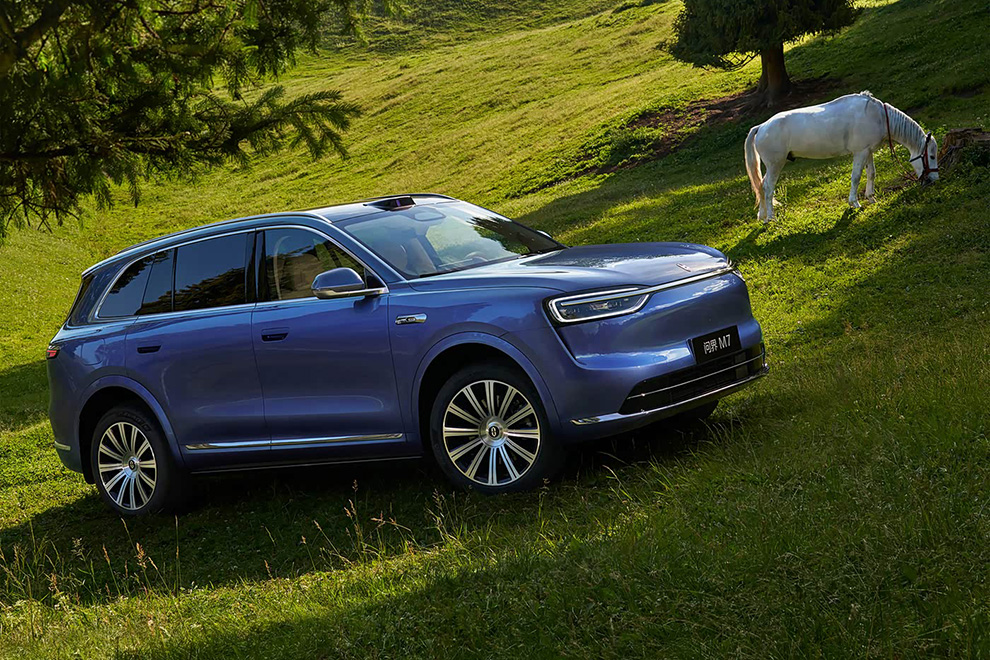
At a glance
- Powertrain choice spans extended range, pure electric and 1.5T petrol.
- Five- and six-seat layouts serve families, executives and mixed fleets.
- Exact battery, range, output, charging and dimensions need unit-level confirmation.
- Landed cost depends on trim, year, condition, freight, Incoterm and destination charges.
- RHD, homologation, parts and aftersales support need market-by-market validation.
Why the AITO Wenjie M7 matters for export markets
The AITO Wenjie M7 matters to export buyers because it combines the proportions and utility expected of a family SUV with several energy paths: extended range, pure electric and 1.5T petrol. That breadth is commercially useful. A distributor can serve an urban fleet with dependable charging access, a regional buyer with limited charging coverage or a customer who still prefers liquid fuel. The five- and six-seat versions also widen the addressable market beyond a single niche. For overseas dealers, that flexibility helps match the product to local infrastructure, duty policy and customer preference.
Within the mid-size and large family-SUV segment, overseas buyers increasingly compare Chinese vehicles on three things: range confidence, cockpit technology and ownership cost. The M7 is relevant because it offers an extended-range option for buyers who want electric daily driving without relying entirely on public charging, as well as a full battery-electric option for markets with strong charging networks. Its petrol versions give conventional fleet operators a more familiar transition path. These are category-level advantages, not a substitute for homologation or market research in each destination market or distributor planning.
For an overseas buyer, the commercial case is not simply that the M7 is a large or well-equipped SUV. It is the ability to build a coherent range around different charging conditions, road coverage and buyer budgets. Dealers can start with one configuration, test demand through a limited order, and expand into complementary powertrains or seating layouts. That makes the model relevant to distributors, executive-fleet specialists and family-SUV retailers, provided each market is homologated and supported properly. Local service capability, parts planning and residual-value assumptions should be assessed before committing to scale.
- Extended-range, pure-electric and petrol paths.
- Five- or six-seat configurations.
- Charging and aftersales determine export fit.
Model range, trims and powertrain variants: how the lineup is structured and how to choose
Treat the M7 lineup as three distinct buying propositions rather than a single gradient from base to top. The extended-range branch combines electric driving with a petrol range extender for longer-distance flexibility. The pure-electric branch is designed around battery charging and includes base, long-range, Max and AWD-labelled configurations. A separate 1.5T petrol branch includes Smart Drive, Plus, Max, Luxury, AWD and 4WD naming. Because equipment can change by trim, never infer a specification from the model badge alone. Ask for the complete homologated equipment list in writing before comparing quotations.
An extended-range M7 usually makes the most sense for a buyer who drives daily in electric mode but needs petrol backup for travel, remote routes or incomplete charging coverage. A pure-electric version is more appropriate where charging is dependable and the buyer values a simpler energy package. The decision should include battery capacity, rated range, charging curve, fuel tank and local electricity versus fuel costs. Exact battery and range figures vary by trim and should be checked on the selected live listing, rather than generalized across the M7 range name.
Seat count and drivetrain are equally important commercial choices. Five-seat M7 versions give rear passengers more space and can suit executive transport, while six-seat versions add a third row for larger families, hotels, airport transfers and mixed fleet use. RWD, AWD and 4WD-labelled petrol variants appear in the line-up, while electrified trims also differ by drive configuration. Match those choices to load, route, tax treatment and resale before deciding on a trim, and verify every output, suspension and equipment figure in the AITO Wenjie M7 specs supplied for that unit.
- Range extender adds petrol backup.
- Pure electric needs reliable charging.
- Battery and output vary by trim.
- Seat count drives fleet fit.
New vs used AITO Wenjie M7: how export inventory is structured and how buyers choose
New and used M7 vehicles require different due diligence. A new vehicle normally offers clearer configuration matching, production-era hardware and a more straightforward condition assessment, although the buyer still needs to confirm production date, factory options, warranty transfer and delivery preparation. A used AITO Wenjie M7 can be attractive when a buyer wants immediate availability, a particular older specification or a lower acquisition commitment. Its value should be judged against condition, service history and remaining aftersales support, not simply against a new-unit asking price or temporary promotion at that moment.
For any used M7, request the VIN, registration or production documents, odometer reading, accident and repair history, service invoices, battery or hybrid-system condition report, and photographs of every body panel, wheel and interior surface. On an electric or range-extended car, battery health and charging performance deserve particular attention; on the petrol 1.5T version, engine condition, coolant, tyres and maintenance history matter more. An independent specialist inspection tied to the exact VIN is sensible when the seller cannot provide evidence. A pre-purchase report should also verify that identification numbers match every document and photographed panel.
The safest buying sequence is to identify the required configuration first, then compare live inventory on condition, specification and documentation. Do not assume a low-mileage used example is equivalent to a new vehicle: charging or software updates, replacement parts, imported certification and remaining warranty can all affect value. Conversely, a new vehicle should not be accepted without checking that the delivered specification matches the contract. Review the current M7 listings, ask for the unit dossier and choose new or used only after the documents support the commercial decision in writing.
- New: verify specification.
- Used: verify VIN and condition.
- Check warranty and homologation.
How export pricing works: the factors behind a live listing price, and how to read one
An AITO Wenjie M7 export price guide must separate the vehicle's transaction value from the cost of getting it into the buyer's hands. Core pricing variables include model year, exact trim, powertrain, seat count, drivetrain, production date, mileage and condition for used units, and any factory or market options. Commercial variables then layer on exchange-rate movement, freight, marine insurance, port charges, inland delivery, documentation, commissions and destination taxes. Incoterm also changes the dividing line, so an ex-port quote must not be compared with a delivered, duty-paid figure without clear scope.
Read a live listing line by line rather than relying on the headline photograph or model name. Confirm the full trim wording, seating, drive configuration, whether the vehicle is new or used, production or model year, VIN, colour, options, mileage where relevant, and whether the displayed amount is the vehicle-only price. Then look for seller location, export readiness, stated Incoterm, payment schedule, inspection rights and validity period. If any field says “check live listing” or “contact seller,” treat it as an unresolved commercial item, not an assumption before placing funds.
The most useful quote is a written pro forma invoice or RFQ response that separates vehicle price, inland transport in China, export handling, freight, insurance, taxes and expected port charges. Ask what is excluded, what triggers a revised quote, and which party bears risk at each stage. Currency and quote-validity periods matter because exchange rates and shipping bookings can move before payment. Current binding prices and per-unit availability must be taken from the live inventory page, while this guide explains the variables that should drive a sensible comparison between sellers.
- Trim, year, condition and options.
- Freight and Incoterms set landed cost.
- Use unit-specific written quotes.
MOQ, ordering and payment: single units vs consolidating a container
MOQ for an M7 order depends on the seller and the way the vehicle is sold; it should never be inferred from a model-level page. Some vehicle offers are available as individual units, while a supplier may impose a lot minimum, especially for parallel exports, container consolidation or customized orders. A dealer seeking to test the market can ask for one-unit terms, but should confirm whether that unit is held exclusively and how long the quotation remains valid. The confirmation must state quantity, unit allocation and whether the MOQ applies.
Buying one vehicle is operationally different from consolidating a container. Single-unit purchasing lowers inventory exposure and allows a dealer to learn buyer feedback before scaling, but freight is usually optimized less efficiently and the vehicle may receive less favourable terms. Container consolidation can improve freight planning and support a broader trim mix, yet it increases capital, storage and sell-through risk. Each vehicle still needs a separate VIN, condition report and allocation record, and the seller must confirm whether mixed-model loading is permitted and who arranges customs clearance and import documents.
Payment structure should mirror the transaction milestones. A typical sequence may involve a reservation or deposit, verification of the vehicle and export documents, payment of the balance, and then release for shipment; the exact sequence is set by the seller and must be documented. Buyers should use a traceable payment method, verify the beneficiary matches the contracting entity, and understand refund, cancellation and ownership-document terms. For AITO Wenjie M7 wholesale purchasing, request an invoice that identifies each VIN and confirms deposit deductions rather than an informal spreadsheet instruction or unverified transfer request before payment.
- Confirm quantity and MOQ.
- Containers increase inventory risk.
- Tie deposits to verified milestones.
Shipping, homologation and market compliance caveats: LHD/RHD and import rules by country
Vehicle freight method must be matched to the M7 unit's dimensions, weight and shipping rules. Ro-Ro is commonly used for completed vehicles, while container or flat-rack options may suit different vehicle envelopes and loading constraints; the exact choice should be confirmed with a specialist forwarder. Transit time and cost depend on origin and destination ports, sailing frequency, route disruption, terminal handling, insurance, permits and inland delivery. Request both planning and realistic schedules, including documentation and customs lead time, rather than treating transport as a simple door-to-door period from factory collection.
Steering configuration is a critical source of ordering error. A Chinese-market M7 should not be assumed to be right-hand drive or export-ready in either configuration. Ask the seller for the VIN, steering side, electrical and lighting specification, and whether a documented conversion is available in the destination market. If conversion is required, price the work, parts, road testing and local approval before paying. Homologation is separate from conversion: a converted vehicle may still need type approval for safety, emissions, noise, radio, software and cybersecurity rules as applicable in the importing country.
Import rules can be stricter for used vehicles and may depend on age, emissions class, roadworthiness, tariff classification and local registration procedures. New cars also require a compliance check rather than an assumption that Chinese approval is sufficient. Before contracting, ask the supplier for the documents they can provide, obtain written advice from the destination authority or an experienced customs broker, and confirm the importer of record, duty and tax treatment, port charges and insurance. For batteries, confirm dangerous-goods documentation and the vehicle's compliance paperwork before booking freight where required.
- Confirm steering side first.
- Conversion is not homologation.
- Check used, battery and customs rules.
Who should buy the M7 — and who should pick a different vehicle
The M7 best fits overseas buyers who want a spacious, technology-oriented SUV and can accept Chinese-brand ownership in their market. It is particularly relevant for distributors building a multi-powertrain portfolio, fleets that need five- or six-seat flexibility, and customers comparing electrified vehicles against conventional premium SUVs. Extended-range versions can reduce charging-range anxiety for regional travel; pure-electric versions suit charging-rich operations; petrol 1.5T versions suit buyers prioritizing familiarity. The strongest case is where local homologation, servicing and residual-value support are already credible rather than assumed from the vehicle's China-market origin alone.
The M7 may be the wrong choice where charging coverage is weak, the importer cannot support its software or battery ecosystem, or a buyer needs the simplest possible fleet transition. A business with high daily mileage should compare total energy and maintenance costs rather than assuming electrification is automatically cheaper. Those needing proven residual values, broad workshop coverage or immediate part availability should investigate rivals before ordering. A low acquisition price cannot compensate for long registration delays, unsuitable software, unresolved type approval or expensive parts logistics in the destination country.
A disciplined decision starts with operating route, charging access, passenger and luggage needs, then serviceability. Build a shortlist with one suitable M7 configuration and at least two credible alternatives, comparing the same metrics: usable range or fuel consumption, safety and driver-assistance equipment, warranty, service intervals, parts lead time, registration cost and expected resale. Fleet buyers should test energy consumption under realistic duty cycles, while dealers should check whether the trim hierarchy creates clear retail price steps. This approach prevents the attractive specification list from distracting from local ownership economics over time.
- Suits multi-powertrain dealers.
- Needs charging, service and parts.
- Less suitable where simplicity leads.
Main rivals and how the M7 compares
Competition comes from both Chinese new-energy brands and established global SUV franchises. Li Auto L6 is a close range-extended, technology-led comparison, while Deepal S07 offers a smaller electrified family SUV; both help buyers test whether the M7's size and six-seat option justify the premium. In the pure-electric segment, BYD Sealion 7 is a more direct Chinese alternative, and Tesla Model Y is the global benchmark for software simplicity, charging familiarity and resale expectations. For petrol-only demand, Toyota and Honda family SUVs remain familiar alternatives, even though their powertrain strategy differs.
The M7's strongest counterargument is breadth: one model family can cover extended range, battery electric and petrol, with five- or six-seat layouts and multiple drive configurations. The L6 and S07 may offer a simpler electrified proposition, while the Sealion 7 and Model Y concentrate on full-electric ownership and benefit from different brand ecosystems. A petrol-focused buyer may value the familiarity of a Toyota or Honda more than the M7's electrified range. The right comparison is therefore route, energy access and passenger count, not badge value or maximum headline range figures.
For an overseas buyer, the M7 can win when seating flexibility and powertrain choice are central, provided local support is secured. It can lose when a buyer wants a globally established service network, a single simple energy strategy or a proven resale model. Compare homologated versions, not showroom or domestic-market specifications, and price each option on delivered cost and support. That makes the M7 a credible export purchase rather than an automatic choice, and it gives distributors a clear basis for narrowing the trim, body and shipment plan before commitment.
- Li Auto L6: smaller range-extender rival.
- BYD Sealion 7: electrified Chinese rival.
- Tesla Model Y: global EV benchmark.
Live AITO Wenjie M7 export inventory
View all listings →Real units currently on ChinaCarDirect with per-unit asking prices and MOQ. Availability updates live from the catalogue.
How to buy a AITO Wenjie M7 from China
-
1
Define the operating case
Set route length, charging access, passenger count, luggage requirements and local operating rules before selecting a powertrain. This prevents a range-extended or pure-electric M7 from being selected on headline figures alone.
-
2
Shortlist live units
Use the current AITO Wenjie M7 listings to compare exact trim, seat count, drive layout, production year and condition. When you buy an AITO Wenjie M7 from China, work from a specific unit rather than a generic model page.
-
3
Verify the unit dossier
Request the VIN, complete specification, production documents, equipment list, condition photographs and service history. For a used vehicle, add an independent inspection and battery or engine condition report.
-
4
Request a written landed quote
Ask for vehicle price, export handling, freight, insurance, port charges, taxes and the applicable Incoterm to be separated clearly. Identify which destination charges are excluded and how long the quotation remains valid.
-
5
Confirm compliance and steering
Check destination import rules, charging requirements, safety approvals, software provisions and steering configuration. Obtain written advice from the local authority or a customs broker before paying.
-
6
Reserve and inspect
Use a traceable payment method, verify the beneficiary and record deposit deductions, refund terms and inspection rights in the contract. Release the balance only after the selected vehicle and documents have been checked.
-
7
Arrange freight and clearance
Book a specialist vehicle carrier using confirmed dimensions, weight, origin, destination and Incoterm. Track the VIN against shipping documents, insurance, customs instructions and the importer-of-record responsibilities.
M7 vs rivals
| Li Auto L6 | A closer range-extended technology comparison, but the L6 is generally a smaller five-seat model and does not match the M7's six-seat option or petrol offering. Choose the L6 for a more compact range-extender package; choose the M7 when cabin volume and configuration breadth matter. |
|---|---|
| BYD Sealion 7 | A close Chinese premium-SUV comparison, with full-electric versions and market-dependent plug-in-hybrid variants. The M7 counters with a wider mix that includes extended range and petrol, while the Sealion 7 is easier to consider for buyers focused on electrified-only portfolios. |
| Tesla Model Y | A globally recognized premium-EV alternative with a mature charging and service ecosystem. It is a strong fit for BEV-only buyers, while the M7 offers more seating and powertrain choices but may require more effort to establish local aftersales and residual-value support. |
Frequently asked questions
How is AITO Wenjie M7 export pricing determined?
An M7 export quote is built from the selected unit's year, trim, powertrain, seating, condition, options, exchange rate, freight route, insurance, port charges and Incoterm. Destination duties and taxes may sit outside the seller's price, so request both vehicle and landed-cost breakdowns. The current live M7 listings show the binding per-unit price and availability.
Which AITO Wenjie M7 powertrain and range options are available?
The M7 range includes extended-range, pure-electric and 1.5T petrol versions, with five- and six-seat configurations. Battery capacity, electric range, motor output, charging rates and petrol drivetrain details vary by trim, so use the exact unit's specification sheet and live listing. Do not substitute a headline range from another M7 version.
Should an overseas buyer choose a new or used AITO Wenjie M7?
A new M7 offers clearer configuration and condition control, while a used vehicle may provide a more specific older specification or immediate market fit. Used purchases demand more scrutiny of VIN, mileage, service and accident history, battery health where applicable, warranty and export paperwork. The better choice depends on total cost, risk tolerance and aftersales needs.
How does MOQ work for an M7 order?
MOQ is set by the individual seller's offer and transaction method, not by the model name. Some sellers quote individual vehicles, while parallel-export or consolidation arrangements may carry a lot minimum. Confirm quantity, unit allocation, exclusivity, deposit and quote validity in writing before payment.
What determines M7 shipping time and cost?
Shipping time and cost depend on vehicle dimensions and weight, Ro-Ro or container options, origin and destination ports, sailing frequency, customs clearance, terminal handling, insurance and inland delivery. A forwarder should quote the route and identify which charges and delays are excluded. Factory collection, documentation and compliance checks should be included in the delivery schedule.
Can spare parts be ordered for an exported M7?
Parts ordering generally relies on the correct model year and VIN, while international supply may take longer than for a globally established marque. Ask whether the seller provides parts diagrams, diagnostic support and export documents, and whether a local dealer or warehouse stocks common service items. Include expected parts lead time in the operating-cost case.
Is a right-hand-drive AITO Wenjie M7 available?
Right-hand-drive availability is unit-specific and must be confirmed before a deposit. Do not assume a Chinese-market M7 is RHD or that a conversion is already completed; request the steering-side specification and a documented conversion quotation where needed. Local type approval and registration rules apply even after a mechanical conversion.
How do I order an AITO Wenjie M7 from China?
Shortlist the live M7 inventory, identify the required powertrain and seating, request the unit dossier and written quote, then confirm compliance, RHD needs, inspection, payment milestones and shipping terms. Place funds only against a verified contract and beneficiary, and make sure the final invoice identifies the selected VIN and agreed Incoterm.
Ready to source the AITO Wenjie M7?
Send your destination, required powertrain, seating and quantity to the ChinaCarDirect RFQ team for a unit-specific export quote.
Request a quote