
AITO Wenjie M9 Export Buying Guide for Dealers
Planning to buy an AITO Wenjie M9 from China? Compare BEV and extended-range trims, pricing logic, MOQ, shipping, homologation and current export inventory.
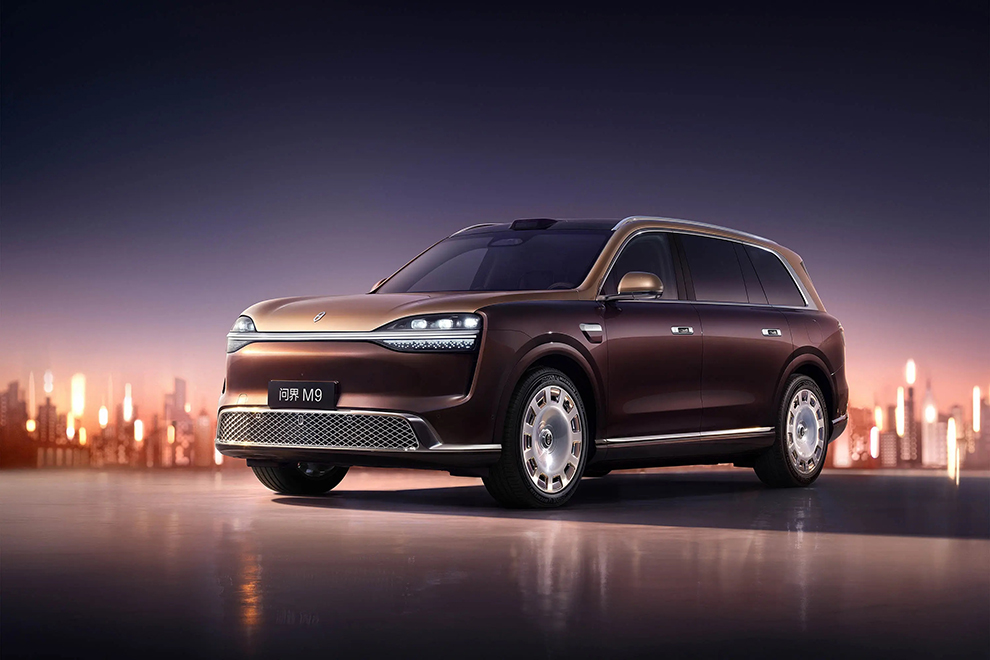
At a glance
- The M9 is a large premium SUV with five- and six-seat layouts for family, executive and fleet buyers.
- Pure-electric versions use a 100 kWh battery, while extended-range versions are offered with 42 kWh or 52 kWh packs.
- Max, Max Edition and Ultra labels indicate the hierarchy, but the VIN-level trim and equipment list should govern comparisons.
- Charging access, fuel availability and local homologation determine whether BEV or extended range is the better operational fit.
- Chinese-origin vehicles require early checks for LHD or RHD configuration, certification, taxation and aftersales support.
- ChinaCarDirect's live inventory provides the binding per-unit export price, MOQ and availability for each M9 listing.
Why the AITO Wenjie M9 matters for export markets
The AITO Wenjie M9 is a flagship in the Chinese large-SUV market, combining sizeable proportions, multi-row practicality and new-energy powertrains in one model. That positioning gives overseas dealers a distinctive product for affluent family, executive-hire and premium-fleet customers who want the space of a full-size SUV without relying on a petrol engine. For export planning, its appeal is not simply size: it combines a cabin proposition with technology-focused hardware that differentiates it from mainstream imports. Its strongest export use case is therefore retail or fleet deployment, rather than price-led volume selling.
International interest is understood as demand for a combination of electric drivetrain choice, premium presentation and usable third-row packaging. Pure-electric versions suit markets with dependable charging networks and fleet policies that reward zero-emission operation. Extended-range versions address buyers who need long-distance flexibility but cannot rely on public charging. Between those use cases, the M9 gives importers a single model family with different infrastructure demands, rather than forcing every customer into one operating profile. That makes configuration discipline more important than headline positioning when vehicles must also satisfy local approval rules.
For a dealer, the M9 should be positioned against premium combustion SUVs and Chinese electrified flagships, not sold as “the cheapest large electric SUV.” Its appeal lies in combining a seating position, available five- or six-seat formats and a choice of battery-powered or extended-range architectures. Fleet buyers should also examine whether the vehicle’s size, energy consumption and after-sales expectations fit their duty cycle. The result is a model that can earn attention in affluent consumer channels while still justifying careful sourcing due diligence before any export commitment is formally signed.
- Five- and six-seat flagship configurations available.
- Pure-electric and extended-range powertrain choices.
- Premium positioning requires market-specific compliance.
Model range, trims and powertrain variants: how the lineup is structured and how to choose
AITO Wenjie M9’s catalogue is organized around three powertrain choices and two seating layouts. Pure-electric versions use the 100 kWh battery family, while extended-range versions appear with 42 kWh or 52 kWh packs. Buyers will encounter Max, Max Edition and Ultra hierarchy labels, plus five- or six-seat body arrangements. The names are useful shorthand, but they are not a substitute for the VIN-level specification. A prudent buyer should reconcile every label with battery size, seating layout, equipment and homologation before comparing quotations, or treating similarly named trims as identical across model years.
The pure-electric branch is the cleaner choice for buyers whose routes and depots have dependable high-power charging and whose operating policy prioritizes zero-emission driving. Its 100 kWh battery is the principal hardware differentiator, but the buyer must still verify the official range rating, charging curve, connector and consumption for the destination market. Range figures may use different test cycles in different documents, so compare like with like. A paper advantage can disappear once cold weather, payload, hills and charging losses are considered. A live specification should properly resolve these points.
Extended-range models use a smaller traction battery and an engine-driven generator to extend driving range, making them attractive where fuel availability is easier than charging coverage. The 42 kWh and 52 kWh versions are distinct propositions: the smaller pack should be judged on electric-only driving and efficiency, while the larger pack may suit buyers seeking more all-electric mileage before generator use. Engine output, generator behavior, fuel type and system output must be confirmed. Do not assume that “range extender” means the vehicle uses the same charging system as a BEV.
- Confirm 100 kWh, 42 kWh or 52 kWh configuration.
- Match five- or six-seat layout to payload needs.
- Treat Max, Max Edition and Ultra as equipment tiers.
New vs used AITO Wenjie M9: how export inventory is structured and how buyers choose
For export inventory, treat new and used M9s as separate procurement channels rather than one interchangeable pool. New examples provide the clearest specification, warranty route and homologation starting point; they are also the core structure through which new-vehicle export programs are planned. Used M9s can make sense for test fleets, demonstration vehicles or buyers seeking a lower depreciation starting point, but their condition, software history and remaining factory support must be verified. Availability of used examples is not guaranteed and should never be inferred from the new-vehicle catalogue.
A new-unit buyer should focus on documentation as much as appearance: factory order sheet, VIN, trim and battery labels, production date, delivery mileage, option list and pre-delivery inspection record. Confirm that the vehicle, its paperwork and the listing all agree before payment. Also establish who arranges homologation and whether modifications for steering position, lighting or charging are disclosed. For a used unit, request an independent inspection, verified service records, relevant battery health information, a diagnostic report and evidence of accident, flood or other major exposure before agreeing on delivery terms.
The economic comparison should be made over the full ownership cycle, not by purchase price alone. A new M9 may carry lower uncertainty but also carry depreciation, insurance and financing assumptions that differ from the used market. A used vehicle can reduce acquisition cost while adding battery degradation, maintenance, software and homologization risks. For fleet pilots or demonstration use, a used example may be preferable to waiting for a new unit, provided the buyer accepts condition and documentation risk. For a resale program, factory-supported new stock is easier to standardize.
- New units: prioritize factory records and warranty clarity.
- Used units: inspect condition, history and battery evidence.
- Compare lifecycle cost, not acquisition price alone.
How export pricing works: the factors behind a live listing price, and how to read one
An AITO Wenjie M9 export price is not a fixed factory rate that can be quoted without context. The amount shown for a live vehicle is shaped by model year, powertrain, battery version, trim level, seating layout, production date and market adjustments reflected by the seller. Mileage and condition also matter for used units. Exchange rates affect conversion into an overseas currency, especially when the quote and payment are separated in time. Freight is a separate commercial variable unless the seller expressly includes it in the stated quote and scope.
When reading a listing, separate the vehicle’s commercial terms from its international landed cost. Check whether the displayed amount is an ex-works price, a port or terminal charge, or an arrangement that extends through customs, insurance and final delivery. The Incoterm should be named because the transfer of risk and cost changes at a defined point. Ask whether the quote includes export declaration, freight allocation, terminal handling, documentation and any hidden destination charges. A lower headline figure can become less attractive once all mandatory port, brokerage or compliance costs are added.
The most reliable way to compare quotes is to normalize them in the same currency, Incoterm, vehicle condition, trim, battery and seat configuration. Ask each seller to state what is included, the validity period, payment milestones, and whether the unit is reserved only after a deposit. Model-year differences can be substantial because hardware, software, options and homologization may change without making the nameplate look different. Use ChinaCarDirect's AITO Wenjie live inventory as the source for current prices and availability, then incorporate destination-specific landed costs before approving any vehicle purchase.
- Normalize every quote to one currency and Incoterm.
- Check inclusion of freight, duties and terminal fees.
- Use live listings for current per-unit figures.
MOQ, ordering and payment: single units vs consolidating a container
MOQ should be read at listing and order level, not assumed from the brand. Some sellers may accept a single vehicle; others may set a larger minimum for a configuration, allocation method or shipment plan. For a test purchase, request a unit-level MOQ and written allocation rules in the quotation. For a wholesale or dealer program, confirm whether a mixed fleet can be consolidated into one container without compromising trim, battery, color or delivery timing. A low minimum does not guarantee an immediate unit, so availability and MOQ should be confirmed separately.
Ordering mechanics should be defined before funds are committed. A typical sequence is specification approval, seller quotation, unit or production allocation, identity and payment details, inspection, balance settlement and release against agreed documents and an appropriate Incoterm. The contract should identify the exact vehicle or acceptable substitution rules, deposit terms, cancellation conditions, document list and dispute process. For a multi-vehicle order, state how options are allocated and whether unsold or delayed units can be replaced without changing the agreed payment schedule. Retain every written confirmation with the production or shipment milestone.
Payment and consolidation should be evaluated together because the cash requirement can be as important as the vehicle specification. If a supplier offers a lower per-vehicle commercial term for container quantities, model it with financing cost, inventory holding time, FX exposure and the risk of a slower sell-through. Compare the cash tied up, documentary-payment requirements, cost of any amendments and the effect of a canceled unit on the balance. A clear pro forma invoice should reconcile the vehicle list, unit price, deposit, balance and any named charges before payment.
- Confirm unit-level MOQ and allocation rules.
- Put vehicle identity, documents and Incoterm in writing.
- Model container consolidation against cash and sell-through risk.
Shipping, homologation and market compliance caveats: LHD/RHD and import rules by country
Start with the destination market's legal and operating requirements, not the assumption that a China-origin vehicle can be shipped and registered. Confirm whether the vehicle must be left-hand-drive or right-hand-drive, and obtain evidence of steering position, lighting, mirrors, seat belts and charging provisions before loading. RHD demand may be met by a market configuration or approved conversion, but the route and cost must be approved before commitment. Conversion can affect homologation, parts support and residual value, so treat it as a separate engineering task and obtain written approval before shipment.
Homologation requirements vary by country and may cover road safety, emissions, electromagnetic compatibility, battery safety and transport, software and cybersecurity, vehicle identification, repair and parts information, noise and lighting. A BEV may have a different compliance path from an extended-range model because the latter includes an engine and fuel system. Import duty, VAT or GST, registration taxes, incentives and local content rules may also change the economics. Engage a destination-country homologation specialist before contracting, and ask the importer to document what has been completed for the specific vehicle and model year.
Freight planning depends on the shipping method, route, port pair, sailing schedule, cargo dimensions and weight, securing requirements, insurance and terminal handling. Compare Ro-Ro with container transport only after obtaining a carrier or forwarder's equipment and route assessment for customs clearance. Large premium SUVs can face height, length or weight restrictions, and actual vehicle dimensions should be verified in final shipping documents. The total landed cost also includes origin handling, customs brokerage, port charges, inland haulage, destination taxes and insurance. Use a fixed landed-cost worksheet for each quote before contracting.
- Verify LHD or RHD before production allocation.
- Commission country-specific homologation review early.
- Validate dimensions, securing and route feasibility.
Who should buy the M9 — and who should pick a different vehicle
The strongest buyer fit is a dealer or fleet operator serving customers who need a premium, multi-row vehicle with genuine electric driving and accept Chinese brand newness in their market. The M9 is especially relevant to family operators, airport and executive transport users, and premium fleets where quiet electric operation and a high seating position matter. A six-seat version may suit passenger capacity priorities, while the five-seat arrangement may provide easier third-row access and a more flexible rear luggage zone. Confirm seating and cargo requirements against the intended market and duty cycle.
The M9 is less suitable for buyers whose brief prioritizes low acquisition cost, compact dimensions, simple servicing or widespread familiarity with European, Japanese or American components. It can also be a poor fit where charging infrastructure is unreliable, extended-range fuel systems are not desired, or fleet managers cannot access manufacturer parts and technical support. Large dimensions may also affect parking, loading and charging economics. A smaller premium electrified SUV may offer a better balance for mixed use, while a combustion model may fit simpler duty cycles. Local service access must be realistic.
Before choosing the M9, compare the operating profile rather than prestige alone. An urban executive buyer with depot charging may favor pure electric, while a regional fleet with long routes and uncertain charging access may place greater value on extended range, provided local fuel and emissions rules permit it. Confirm whether customers recognize AITO, whether right-hand-drive and local certification are essential, and whether aftersales coverage can support the promised service interval. The strongest purchase is the configuration that can be supported over its whole ownership period, not merely delivered to the buyer.
- Best for premium families, executive transport and selected fleets.
- Less suitable for compact, low-cost or low-support operations.
- Choose powertrain from real duty cycles and charging access.
Main rivals and how the M9 compares
The Li Auto L9 is the direct conceptual rival because it targets large Chinese family SUVs with an extended-range electric architecture and multi-row packaging. The choice between it and the M9 depends on brand acceptance, powertrain mix, equipment, local service support and the precise seat and battery configuration. An importer considering either model should test both against local charging and fuel use, not assume that one is more suitable. The M9's two seating layouts and broader emphasis on BEV options distinguish it from a more range-extender-focused proposition for local fleets.
NIO's ES8 is a closer benchmark for buyers focused on a premium large battery-electric SUV, especially where the M9 is considered in BEV form. Both vehicles can be evaluated around passenger space, ride and feature strategy, charging requirements and the cost of supporting them outside China. However, NIO's brand, battery-swap ecosystem, service network and market positioning can shape the comparison in ways that do not transfer to the M9. Treat dealer support, certification and spare-parts planning as commercial requirements, not afterthoughts. Local homologation and aftersales capability can outweigh badge familiarity.
The BMW X7 provides a useful luxury benchmark because it competes for large-SUV customers who value premium cabin space and a six- or seven-seat environment. Compared with the M9, the X7 may appeal to buyers who prioritize established residual-value perceptions, familiar dealer servicing or a combustion powertrain, whereas the M9 can offer fully electric and extended-range configurations plus China-focused technology. The decision is therefore not “Chinese value versus German badge”; it is a comparison of operating costs, certification, aftersales and the exact powertrain rather than relying on brand recognition alone.
- Li Auto L9: closest range-extender family-SUV alternative.
- NIO ES8: direct premium large-BEV benchmark.
- BMW X7: global luxury and ownership-familiarity benchmark.
Live AITO Wenjie M9 export inventory
View all listings →Real units currently on ChinaCarDirect with per-unit asking prices and MOQ. Availability updates live from the catalogue.
AITO Wenjie AITO M9 2024 Pure Electric Max Edition 100kWh 6-Seater
How to buy a AITO Wenjie M9 from China
-
1
Define the destination and duty cycle
Identify the destination market, required seating, typical route length and available charging or fuel infrastructure. These factors determine whether a BEV, extended-range model or another vehicle is more suitable.
-
2
Shortlist exact vehicles in live inventory
Open the live AITO Wenjie M9 listings on ChinaCarDirect and compare matching configurations. Treat the price, MOQ and availability shown against each unit as the current source of truth, then request a written quotation.
-
3
Verify the VIN-level vehicle
Ask the seller to confirm the VIN, model year, trim, battery and seat configuration, production date, mileage, factory options and ownership documents. Ensure the physical vehicle and listing agree.
-
4
Request a landed-cost quotation
State the preferred Incoterm and ask whether freight, insurance, export declaration, customs, duties, port charges and destination delivery are included. Compare quotations using the same currency and scope.
-
5
Complete the compliance review
Confirm local homologation, emissions, battery, lighting, charging and tax requirements with a destination-country specialist. Approve any steering-position conversion or other modification before shipment.
-
6
Contract, pay and inspect under agreed milestones
Document vehicle allocation, substitution rules, deposit and balance terms, cancellation conditions, required documents and inspection rights. Tie payment and release to verifiable production or shipment milestones.
-
7
Book freight, customs and delivery
Use an experienced vehicle forwarder to confirm route feasibility, securing, insurance and shipping documents. Track customs clearance and final delivery, and agree the local parts and aftersales support plan before release.
M9 vs rivals
| Li Auto L9 | Both are large Chinese family SUVs, and the L9's range-extender focus makes it a close conceptual competitor for buyers prioritizing flexible long-distance use. The M9 is more differentiated for operators wanting a broader BEV/EREV choice and either five- or six-seat layout. |
|---|---|
| NIO ES8 | The ES8 is a closer battery-electric benchmark for premium large-SUV buyers seeking multi-row packaging and advanced vehicle technology. The M9 offers a broader combination of BEV and extended-range configurations, but local certification, charging access and service support may determine the better commercial fit. |
| BMW X7 | The X7 is a useful global luxury benchmark for large-SUV customers who prioritize established brand familiarity, premium space and traditional powertrain options. The M9 differentiates through Chinese-focused technology and broader electrified configuration, while the final decision should consider certification, operating costs and aftersales. |
Frequently asked questions
How is AITO Wenjie M9 export pricing determined?
A live export price reflects the specific vehicle's model year, powertrain, battery, trim, seating, condition and seller terms, and may also be affected by currency movements. Freight, insurance, customs, taxes and port handling can sit inside or outside that amount, so compare quotes using the same currency and Incoterm. Current per-unit prices are shown in the live AITO Wenjie M9 listings on ChinaCarDirect.
Which powertrain and range options are available?
The export range includes pure-electric versions with a 100 kWh battery and extended-range versions with 42 kWh or 52 kWh traction batteries, in five- or six-seat layouts. Published driving range, motor output, charging rates and combined range for an EREV can differ by trim, model year and test cycle, so check the live specification rather than relying on a headline figure.
What are the trade-offs between a new and used M9?
New M9s generally provide clearer factory configuration, warranty access and standardization for resale. A used M9 may suit fleet pilots or demonstrations, but buyers should verify service history, battery condition, accident or flood exposure, software status, odometer reading and ownership documents before purchase.
How does MOQ work for an M9 export order?
MOQ is set on each listing or order rather than by model name. Some offers may accept one unit, while others use an allocation minimum or container-based requirement, so confirm the live unit and written terms. For multiple vehicles, ask how trims and delivery dates are allocated and whether delayed units can be replaced without changing the payment schedule.
How long does shipping take and what does it cost?
There is no universal transit time or freight charge for the M9. The route, sailing schedule, port pair, carrier space, cargo dimensions and weight, securing, insurance, customs process and destination charges all affect the result. Obtain a forwarder's landed-cost quote under the same Incoterm used for competing vehicle quotations.
Can spare parts be supplied for an exported M9?
Parts planning is especially important for a China-origin premium model entering a new market. Before ordering, confirm channel availability, typical lead-time methods, diagnostic and software support, warranty documentation and access to consumables. Treat the aftersales commitment as part of supplier selection rather than an afterthought.
Is a right-hand-drive M9 available for export?
RHD availability must be confirmed for the individual vehicle and market; it cannot be inferred from the M9 name. Ask for the steering-position evidence and either source an approved RHD configuration or approve a conversion before production. A conversion can affect homologation, cost, parts support and residual value.
How do I order an AITO Wenjie M9 from China?
Start with the live inventory, select a specific vehicle and request a written quotation covering configuration, MOQ and Incoterm. Approve the contract and payment milestones, verify the vehicle and inspection records, then align shipping documents, insurance, customs and balance payment with the agreed release conditions.
Ready to source the AITO Wenjie M9?
Request a current AITO Wenjie M9 export quote with the exact unit, Incoterm, MOQ, compliance path and freight assumptions.
Request a quote