
Audi Q4 E-tron Export Buying Guide for Overseas Dealers
Buy an Audi Q4 E-tron from China with a clear view of trims, battery and range options, export pricing, MOQ, shipping and market compliance requirements.
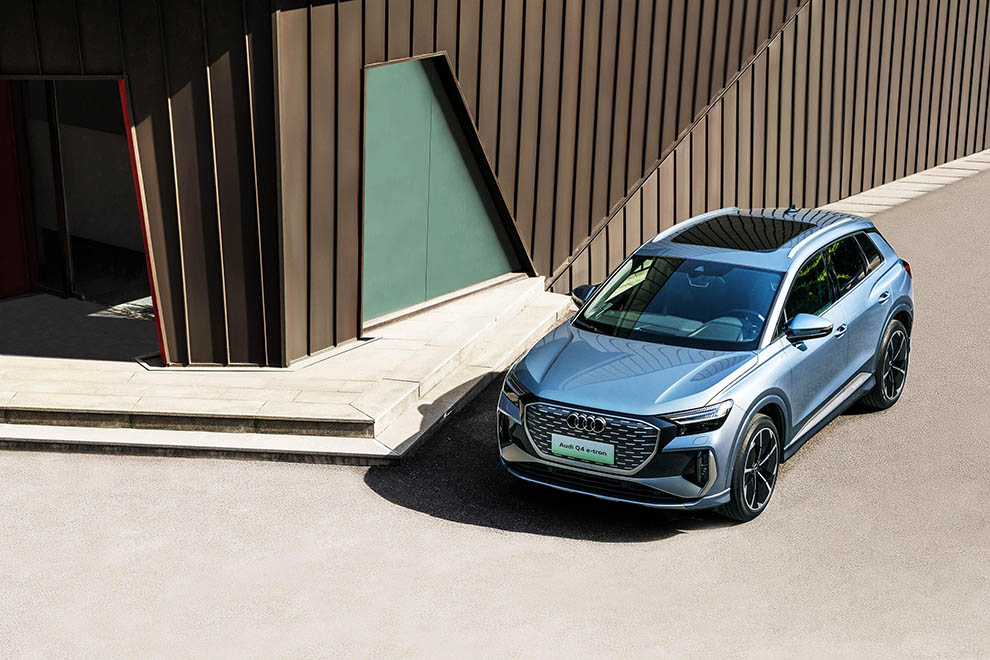
At a glance
- The Q4 E-tron is a compact premium BEV suited to urban fleets, company cars and dealer demonstration programs.
- The 40 e-tron pairs one rear motor with rear-wheel drive, while the 50 e-tron quattro uses dual motors and all-wheel drive.
- China-market battery and CLTC range data must be checked against the exact model year and destination-market test cycle.
- Export pricing should be assessed with trim, condition, Incoterm, freight, duties and local taxes kept separate.
- Single-unit and consolidated purchasing paths should be confirmed on the live listing before payment.
Why the Audi Q4 E-tron matters for export markets
The Audi Q4 E-tron occupies a middle ground in the premium electric SUV segment: it carries Audi’s design, cabin and brand identity, but uses a battery platform rather than a combustion powertrain. For dealers, that combination can appeal to company-car customers and fleet managers who want a premium name in a manageable package. It is also easier to position beside compact crossovers than a full-size luxury EV, while giving buyers the low-noise, instant-response character associated with battery-electric driving. Its model familiarity also simplifies product education for importers entering a new electric SUV category.
For wholesale programs, export demand is strongest where charging access, urban operating costs and premium EV awareness matter more than maximum cargo space. The Q4 E-tron can serve as a company car, airport or hotel shuttle, sales demonstrator, or mixed fleet where drivers need a familiar premium badge and comfortable daily usability. At the same time, its imported Chinese specification should not be marketed as a European-spec car without checking charging, software, warranty and homologation details. The right buyer sees global appeal as a starting point, then validates the exact vehicle against local use.
Rather than treating the model as one generic listing, buyers should match its size and performance to their market. Dealer groups can compare rear-wheel-drive Q4 E-tron fleet economics with all-wheel-drive applications, while private buyers may prioritize comfort, software and charging convenience. ChinaCarDirect’s live Audi inventory is the practical place to compare the trims and unit details actually offered, and an RFQ should specify the destination, intended use and required documents. That approach turns a broadly attractive model into a vehicle that can be sold and supported responsibly in the destination market.
- Compact premium BEV positioning.
- Familiar Audi brand appeal.
- Range claims need cycle context.
Model range, trims and powertrain variants: how the lineup is structured and how to choose
The lineup is built around two useful starting points. The 40 e-tron uses a single motor and rear-wheel drive, emphasizing efficiency, predictable road use and lower drivetrain complexity. The 50 e-tron quattro adds a second motor and all-wheel drive for greater traction, particularly useful in wet climates, hilly regions or fleet applications that value stability. Edition names such as Creation, Pioneer, Innovation, First and Night describe market-specific equipment levels; they should not be interpreted as a simple universal ladder. Ask for the complete equipment list tied to each VIN and production year.
Battery capacity and range are key variables, and both can change with model year and market. Early China-spec 40 e-tron cars commonly use an 82 kWh gross pack with 52.6 kWh net capacity, while the 50 e-tron quattro commonly uses a 100 kWh gross and 77 kWh net pack. Published Chinese range figures use CLTC, so they should not be compared with WLTP or EPA results. For fleet planning, convert the relevant cycle figure into real route loss, charging downtime and weather allowances rather than presenting it as guaranteed operating range.
Choosing a trim should begin with the drivetrain and then move to equipment that drivers will use. Comfort seats, climate control, driver-assistance functions, infotainment, luggage capacity and charging access can matter more than an edition badge. A fleet buyer may prioritize durability, key control, navigation and serviceability; a dealer may need a visually strong demonstrator with a wider option set. Because software and equipment can differ by production period, verify the exact vehicle, market of origin and supported functions before finalizing the order. This is especially important when planning a multi-market stock program.
- 40 e-tron: one rear motor, RWD.
- 50 quattro: two motors, AWD.
- Edition equipment changes by year.
New vs used Audi Q4 E-tron: how export inventory is structured and how buyers choose
ChinaCarDirect separates export opportunities by vehicle condition, so buyers should first decide whether a new car best supports their sales model. A new Q4 E-tron offers a known manufacturing history, standardized specification and warranty path, although delivery timing and configuration availability still need confirmation. A used example may suit a buyer seeking a lower acquisition outlay or a former-fleet vehicle. The live listing must be treated as the source of truth for condition, title, mileage and availability rather than assuming what the marketplace generally holds at the time of purchase.
New inventory carries less uncertainty about battery degradation, prior repairs and undisclosed accident work, which matters because high-voltage components are integral to an EV’s value. Its acquisition cost can be higher, and the buyer should assess depreciation, insurance and whether the local aftersales network can support the model. Used vehicles can deliver better value when battery condition, service history and remaining warranty are documented, but headline price alone is not enough. Ask for battery state-of-health evidence and an inspection that covers chassis, tires, software and high-voltage safety before any balance is released.
The best comparison is risk-adjusted rather than purely numerical. For a first-time importer or company fleet, a documented new unit may reduce technical and resale uncertainty; for an experienced buyer with inspection capability, a carefully selected used car may make more sense. Compare equivalent editions and drivetrains, not vehicles with different equipment at superficially similar numbers. A used-car purchase agreement should also cover the transfer of any remaining factory warranty, maintenance records, battery test reports, title status and the exact consequences if a pre-delivery inspection identifies an undisclosed issue before final payment.
- New: clearer history and warranty.
- Used: lower entry cost, more risk.
- Request battery health evidence.
How export pricing works: the factors behind a live listing price, and how to read one
An export price is not a single manufacturer-style number. It is a unit-specific quote built from the vehicle’s asking price plus, where applicable, transport, insurance, handling, documentation and destination charges. The Incoterm is decisive because it defines where responsibility passes from seller to buyer. A buyer comparing one listing with another must first establish whether each figure is on an ex-works, FOB or delivered basis. Import duty, VAT or equivalent taxes, registration fees and local dealer margins normally sit outside the vehicle quote and must be calculated separately by the importer.
The asking price moves with model year, 40 e-tron versus 50 e-tron quattro, battery specification, edition, factory options, mileage, condition and how many vehicles are available at the relevant moment. Currency movements also matter, as can freight demand, sailing schedule, port charges and insurance coverage. A vehicle with desirable equipment may command more than a base example, while a used unit’s price may reflect remaining life and repair history. These are reasons to request a refreshed quote, not grounds for publishing a fixed export-price band that could become misleading for a particular shipment.
To read a live listing correctly, open the unit record and record its SKU, model year, trim, VIN or identifying details, condition, listed price and stated terms. Then ask the seller for a written quotation that identifies included accessories, documentation, warranty, payment milestones and the location from which the car departs. Check whether similar-looking records refer to the same physical vehicle, because duplicated photographs or repeated SKUs are not proof of separate stock. ChinaCarDirect’s live Q4 E-tron listings are the binding source for current unit pricing, and the landed-cost worksheet should be built from those fresh figures.
- Compare identical years, trims and options.
- Confirm Incoterm and quote exclusions.
- Add duties, taxes and freight separately.
MOQ, ordering and payment: single units vs consolidating a container
Minimum order quantity is set by the seller and shown for the particular listing, so buyers should not assume that every vehicle requires a container or that one unit is always available. Some sellers may accept a single-car order; others may set a larger lot condition or offer separate vehicle and consolidated freight arrangements. Before payment, ask what quantity the quoted SKU covers and whether the MOQ applies per trim, model or shipment. For a fleet program, request a written stock-allocation proposal with VIN-level allocation rather than relying on a general availability statement.
Container consolidation can reduce freight cost per vehicle, but it adds planning work and risk. A buyer may combine several Q4 E-tron trims, or mix vehicles with similar dimensions and shipping requirements, subject to the forwarder’s slot, axle-load, weight-distribution and securing plan. Used and new units should not be mixed merely to fill space; their documentation, inspection status and insurance terms may differ. Build the allocation around confirmed units, realistic sailing dates and a reserve margin for inspection findings, rather than filling a container with unverified options that may not arrive in time.
Payment structure should be matched to control. A workable sequence normally separates an agreed deposit from the balance due after identity, condition and document checks, with the contract naming the authorized seller and beneficiary. It should also state the inspection period, cancellation and refund conditions, Incoterm, delivery deadline and warranty remedy. Independent inspection is particularly valuable before final payment because it reduces the chance that an overseas buyer pays for damage, incomplete documents or a vehicle that differs from the agreed specification. ChinaCarDirect’s contact channel can be used to request the unit-specific order terms.
- Check MOQ on each live SKU.
- Consolidate only confirmed allocations.
- Link payment to inspection milestones.
Shipping, homologation and market compliance caveats: LHD/RHD and import rules by country
Ocean freight follows a sequence: inspection and payment, document preparation, export customs, port handling, loading, voyage, discharge and destination clearance. As a battery-electric vehicle, the Q4 E-tron must be declared and handled as a dangerous-goods shipment, with the forwarder confirming packaging, UN 38.3 test information, safety data, battery description and carrier routing requirements. Transit insurance should cover the vehicle from the agreed delivery point to destination. The importer should monitor milestones rather than rely only on a booking confirmation, especially where port congestion or a sailing rollover can disrupt the delivery schedule.
Steering arrangement is a market-specific issue, not a cosmetic preference. China-built examples are commonly left-hand drive, while some destination countries permit only right-hand drive or have customer expectations aligned with it. Factory-produced right-hand-drive cars may be available from some sources, but converting a left-hand-drive vehicle is not simply a matter of moving the steering wheel: lighting, instruments, controls, safety systems and type approval may be affected. State the required configuration before ordering and have the destination importer confirm that the VIN and steering arrangement will be accepted for registration before funds are committed.
Import compliance differs by country and can change over time. Duties, VAT or sales tax, battery or carbon-related charges, environmental incentives, low-emission-zone access and local fleet rules all affect the business case. The importer may also need a VIN check, customs valuation, radio-frequency approval, software declarations, local-language materials, valid warranties and proof that the charging connector and electrical supply are suitable. Do not assume a China-market Q4 E-tron is automatically homologated elsewhere. Obtain a destination-specific regulatory checklist and written advice from a licensed customs broker before release, shipment or final payment.
- Treat the battery as regulated cargo.
- Confirm steering configuration early.
- Use destination-specific customs advice.
Who should buy the Q4 E-tron — and who should pick a different vehicle
The Q4 E-tron is a candidate for dealers serving premium EV buyers, company-car programs, hotel and corporate fleets, and drivers who value a familiar luxury badge with electric running costs. Rear-wheel-drive 40 e-tron examples can suit fleets focused on efficiency and straightforward charging, while the 50 e-tron quattro can better answer demand for all-wheel traction. Its compact dimensions also help where parking and road access are constraints. The vehicle works best where charging is dependable, daily routes are predictable and the operator can support premium EV servicing over several years of ownership.
It is less suitable for buyers who need a long-established combustion-engine product, seven-seat practicality, heavy towing capability or the lowest acquisition cost. Drivers without reliable home or workplace charging should compare the cost of public charging and range margin against alternatives. Fleets that cannot secure trained EV technicians, diagnostic tools, replacement parts or insurance should address those constraints before purchase. A prestige badge also does not eliminate residual-value risk, especially where imported models have thin local sales history or limited warranty support. Those issues can outweigh the appeal of the badge.
The decisive question is whether the buyer can use the vehicle’s strengths without carrying avoidable infrastructure and compliance costs. For a corporate fleet, compare total operating cost, duty cycles, charging windows, downtime and residual assumptions rather than purchase price alone. For a dealer, compare likely customer demand, charging compatibility, homologation effort and parts support against models with a stronger local footprint. If those conditions are not met, a more mainstream EV or a locally supported premium model may offer a lower risk purchase despite giving up some of the Q4 E-tron’s refinement for the target market.
- Suitable for urban premium EV fleets.
- Best where charging is dependable.
- Weaker where service support is thin.
Main rivals and how the Q4 E-tron compares
The Tesla Model Y is the most direct alternative for buyers who prioritize charging simplicity, strong software, broad availability and a large global service network. It can be easier to explain where buyers already know the Tesla ecosystem, and its energy efficiency helps fleet economics. The Audi counters with a more conventional premium-cabin presentation, a distinct badge and the Q4 E-tron’s compact-SUV positioning. Which wins depends less on a feature checklist than on local charger compatibility, expected resale and the aftersales experience each dealer can support in the destination market.
The BMW iX1 competes directly with premium-brand expectations and is aimed at similar electric-SUV buyers. Drivers coming from BMW may prefer its brand-specific interface and road character, while the Q4 E-tron benefits from Audi presentation and a choice of rear-wheel-drive or quattro configurations. The deciding factor in an export program is market readiness: verify local certification, charging, spare-parts support and residual-value assumptions for each. A model with stronger regional uptake can be easier and less costly to stock despite an attractive specification on paper when entering a new destination market.
The Mercedes-Benz EQB is another relevant rival, particularly for buyers who associate a three-row-shaped premium SUV with the Mercedes name. Its packaging and brand appeal can compete for family and executive demand, although buyers should examine actual rear-seat and cargo usability rather than assuming equivalent space. The Q4 E-tron offers a more focused electric-platform alternative and established Q4 model recognition. For importers, compare verified dimensions, equipment, delivery arrangements and local support, then secure a unit-specific Q4 E-tron quote before deciding whether its positioning and expected after-sales margin are stronger for the intended customer.
- Model Y prioritizes ecosystem efficiency.
- BMW iX1 emphasizes brand familiarity.
- EQB targets executive and family appeal.
Live Audi Q4 E-tron export inventory
View all listings →Real units currently on ChinaCarDirect with per-unit asking prices and MOQ. Availability updates live from the catalogue.
How to buy a Audi Q4 E-tron from China
-
1
Define the destination and operating requirement
Specify the import country, charging setup, steering configuration, annual mileage, load and aftersales expectations. These details determine which trims and homologation work are relevant.
-
2
Shortlist the appropriate live units
Review the live Q4 E-tron inventory by model year, 40 e-tron or 50 e-tron quattro, edition, condition and visible equipment. Use the live listing to confirm current price, MOQ and availability for each unit.
-
3
Request a written quotation
Ask for a vehicle-level quote identifying the SKU or VIN, condition, options, Incoterm, payment milestones, warranty, delivery location and included documents. Clarify which costs are excluded.
-
4
Verify the vehicle before payment
Review production year, battery version, charging system, software, mileage, title and service history. Use an independent inspection for condition, high-voltage safety, tires, bodywork and delivery readiness.
-
5
Confirm MOQ and payment terms
Establish whether the MOQ applies per trim, SKU or shipment, and whether vehicle purchase and freight consolidation are separate commitments. Put inspection, cancellation, refund and warranty conditions in the contract.
-
6
Arrange compliant shipping
Engage a destination-licensed customs broker and EV-experienced freight forwarder to confirm import rules, dangerous-goods handling, insurance and the charging or radio adaptations required. Track the shipment through each milestone.
Q4 E-tron vs rivals
| Tesla Model Y | The Model Y is a direct alternative for buyers prioritizing charging simplicity, software and a broad service footprint. The Q4 E-tron offers a more conventional premium cabin, a distinctive Audi identity and a compact-SUV format. |
|---|---|
| BMW iX1 | The BMW iX1 competes for premium-brand buyers who value its familiar interface and road character. The Q4 E-tron provides a comparable premium-electric proposition with rear-wheel-drive and quattro drivetrain choices. |
| Mercedes-Benz EQB | The EQB targets executive and family buyers with a larger, three-row-shaped premium SUV. The Q4 E-tron is the more focused compact electric alternative, so buyers should compare usable passenger and cargo space rather than badges alone. |
Frequently asked questions
How is Audi Q4 E-tron export pricing determined?
Each live unit is priced from its model year, trim, drivetrain, battery version, options, condition and the seller’s current terms. Freight, insurance, port charges, exchange rates and the chosen Incoterm can change the delivered amount, while import duty and local taxes normally sit outside it. Open the live Q4 E-tron inventory for the current vehicle-level price and request a written quote that confirms inclusions and exclusions.
What powertrain and range should I expect?
The 40 e-tron is a rear-wheel-drive BEV with one motor, while the 50 e-tron quattro has two motors and all-wheel drive. Battery capacity and published range vary by model year; common China-spec cars use CLTC, which should not be compared directly with WLTP or EPA. Verify the exact battery, range label and charging specification on the live listing.
Is a used Audi Q4 E-tron a better export purchase?
New cars usually reduce uncertainty about battery wear, accident repair and service history, while used cars can reduce entry cost but carry more condition risk. Used-buyer due diligence should include battery state-of-health evidence, high-voltage inspection, title, service records, remaining warranty and a pre-delivery inspection. Never rely on a used listing’s headline price without checking the unit-specific report.
What is the MOQ for an Audi Q4 E-tron?
MOQ is set per listing or seller, not by the model name alone, and the live unit record is the source for the current requirement. Ask whether it applies to one trim, one SKU or the whole shipment, and whether single-vehicle and consolidated freight arrangements are available. Put the quantity, allocation and any consolidation deadline in the written order terms.
What determines shipping time and cost?
Shipping time and cost are quotation-specific. Transit time depends on origin port, destination port, sailings, transshipment, customs clearance and congestion, while cost is driven by freight method, route, vehicle count, weight distribution, insurance, port charges, Incoterm and currency. Ask the freight provider for a written schedule and all-in cost, and include those amounts in the landed-cost sheet.
Are spare parts and warranty support available?
Parts availability depends on destination-country Audi support, model year, drivetrain and the ability of local distributors to source high-voltage components. Before ordering, request a parts and warranty plan covering body, charging and high-voltage items, diagnostic support and expected lead times for commonly replaced parts. A local Audi presence does not automatically guarantee every regional part is held in stock.
Can overseas buyers obtain a right-hand-drive Q4 E-tron?
China-built Q4 E-trons are commonly left-hand drive, so right-hand-drive buyers should request factory-produced examples or obtain advance approval for any conversion. A conversion can affect lighting, controls, safety systems and homologation, and may reduce residual value. Confirm the steering configuration, VIN and acceptance for registration in writing before funds are committed.
How do I order an Audi Q4 E-tron from China?
Start with the live Q4 E-tron listings, then send the seller your destination, trim, quantity, timeline and document requirements. Obtain a unit-specific quotation with VIN, condition, Incoterm, payment milestones, warranty and delivery terms, followed by inspection and customs advice before payment. The RFQ channel provides the route for requesting current pricing and order mechanics.
Ready to source the Audi Q4 E-tron?
Send your destination, preferred trim, quantity and delivery timeline through the RFQ channel for a unit-specific Q4 E-tron quotation.
Request a quote