
BYD E2 Export Guide for Dealers, Fleets and Importers
Buy BYD E2 vehicles from China with guidance on trims, battery range, used-unit checks, export pricing, MOQ, shipping and market compliance for importers.
At a glance
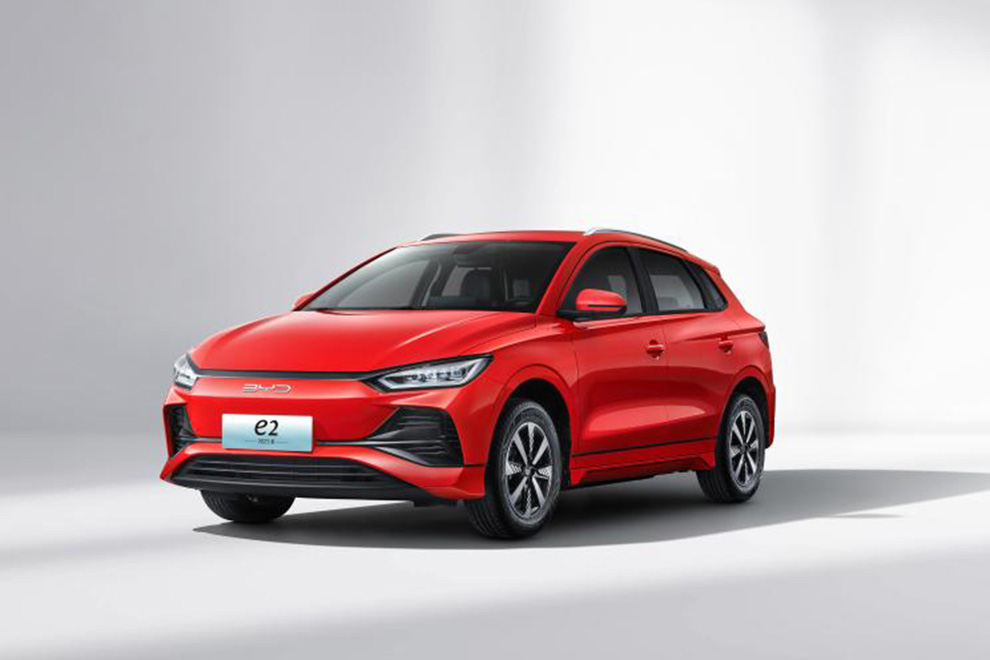
- The BYD E2 for export is a compact five-door BEV suited to urban fleets and private buyers.
- Standard-, extended- and long-range versions need year-by-year specification verification.
- Used-unit value depends on battery health, mileage, repair history and warranty transfer.
- Current price, MOQ and availability belong to each live listing or written quotation.
- LHD or RHD availability, charging compatibility and homologation are destination-specific.
- Strong fit for predictable routes with dependable charging and local service support.
Why the BYD E2 matters for export markets
The BYD E2 is a compact five-door battery-electric hatchback positioned where affordability, usable packaging and straightforward urban transport matter more than premium performance. For overseas dealers, it offers a smaller BYD alternative to larger models such as the Dolphin while retaining the practicality of a five-door car. That makes it relevant to importers seeking an entry-level electric fleet vehicle, private-sale stock or a platform capable of serving several budget-oriented mobility segments without moving into a larger and generally more expensive class, with familiar BYD branding and a logical fleet-cost profile.
The model’s strongest export logic is operational rather than aspirational. Dense cities, large ride-hailing fleets, campuses, airport transfers and short regional commuter routes can all benefit from a compact EV with frequent opportunity to recharge. Lower component complexity than a combustion powertrain can support predictable operating costs, although real savings depend on local electricity tariffs, insurance, maintenance, depreciation and utilization. Buyers should therefore model charging time and duty cycles rather than assuming that “electric” automatically means inexpensive in every market, especially where vehicles spend long hours idling or face high energy costs.
Demand should still be treated as market-by-market, not assumed from BYD’s global reputation. The E2 has been developed primarily for the Chinese market, so an overseas buyer must confirm steering configuration, local type approval, charging compatibility, software language, parts support and warranty coverage before committing. A model that fits a city fleet in its home market may have weaker resale prospects where charging networks, service standards or emissions-related rules differ. The opportunity is real when local infrastructure and compliance work support it, and the importer can sustain service demand responsibly.
- Compact five-door BEV.
- Urban-fleet fit.
- Local approval is essential.
Model range, trims and powertrain variants: how the lineup is structured and how to choose
BYD E2 trims combine equipment grade with battery-range designations, but the naming has changed across model years and special editions. The market includes labels such as Luxury, Comfort, Deluxe, Standard and Honor Edition, alongside upgraded, premium, long-range and standard-range versions. These names are useful for locating the right listing, yet they should not be treated as a universal equipment dictionary. When comparing BYD E2 specs, confirm model year, battery edition, motor output, infotainment, safety equipment and whether the seller’s description matches the vehicle identification number and factory configuration documents where available.
Because the E2 is a battery-electric car, its “extended range” and “long range” labels refer to battery-powered distance rather than a conventional petrol engine acting as a generator. Nevertheless, buyers should ask for the battery capacity, rated test-cycle range and usable charging specification for the exact vehicle. Chinese-market CLTC figures are useful for identifying the version, but they are not directly comparable with WLTP or EPA results. A long-range label also says little about condition in a used car, where age, charging habits and prior high-heat or high-charge operation may affect remaining capacity.
Choose in two stages: first establish the range and mechanical platform you need, then select the trim for equipment and condition. For fleet use, prioritize usable range, fast-charging compatibility, cabin durability and the availability of repair support over decorative options. For private buyers, compare warranty transfer, software features, comfort equipment and replacement-parts pricing against expected holding costs. On any used example, request battery state-of-health evidence, a charge-cycle history where available, diagnostic results and documented accident repair; a clean exterior alone cannot establish mechanical quality before payment or shipment is authorized.
- Choose range before trim.
- Verify battery and charging.
- Extended range is battery-based.
New vs used BYD E2: how export inventory is structured and buyers choose
ChinaCarDirect’s live BYD E2 inventory should be treated as a unit-by-unit catalogue rather than a factory-new model programme. Available examples can span different model years, range editions and equipment grades, and each listing should be judged from its own photographs, identification details, condition report and commercial terms. This structure suits buyers who want to choose a specific vehicle rather than accept a generic specification. It also means that exact price, minimum order quantity and availability must always be confirmed on the live listing or in a written quotation before purchase.
Used E2 vehicles can attract buyers who want a known car and prefer to limit initial capital exposure. Their condition can be easier to relate to the quoted price than an abstract new-car specification, because mileage, battery history and visible wear are part of the vehicle’s story. The trade-off is uncertainty: an older battery, limited warranty, high-load component wear or imperfect accident documentation can create costs that are not visible in photographs. A factory-new car, when available in the destination market, offers a more standardized handover and clearer warranty framework.
The decision should be based on a total-cost comparison, not on the vehicle badge alone. For a used car, obtain a battery state-of-health report, clarify remaining warranty, inspect tyres, suspension, brake wear, cabin and charging hardware, and verify service history and title documents. For a new purchase, confirm that local homologation and warranty service actually exist. Across both routes, assess the likely resale market, parts lead time, technician availability and insurance classification, since these factors often determine whether an apparently affordable EV remains economical after handover to the importing business.
- Inspect every used unit.
- Prioritize battery history.
- Confirm warranty support.
How export pricing works: the factors behind a live listing price, and how to read one
There is no defensible fixed export price for a BYD E2 because each listing represents a different vehicle and commercial proposition. The vehicle-side drivers include model year, trim, battery or range edition, mileage, exterior and interior condition, service history, accident repair, optional equipment and whether the battery warranty remains transferable. Market-side drivers include the renminbi exchange rate, Chinese domestic pricing, dealer margin, insurance, inspection, documentation, port charges and inland transport. A seller quote and a live listing price are therefore starting points for comparison, not universal valuations for this model.
Shipping can change the amount a buyer actually pays, depending on the Incoterm and the destination. An ex-works price excludes most transport and export handling; FOB normally places responsibility at the named origin port; CIF can include freight and minimum insurance to a named destination port. Those shorthand terms do not remove local import duty, VAT or taxes, customs clearance, destination charges or inland delivery. For a vehicle purchased for resale, compare the complete landed cost per unit, including port handling, documentation, storage and the cost of delays or corrective work.
Read each live listing rather than comparing headline figures alone. Check the stated year, trim, range edition, mileage, condition, steering side, battery warranty and included documents; then ask the seller to confirm omissions in writing. Establish whether the displayed amount is vehicle-only, includes export preparation, or reflects a particular Incoterm. Request a validity period and a pro forma invoice showing the currency, payment stages and what happens if exchange rates, freight or inspection results change. Current binding numbers should be taken from the live inventory and the buyer’s written quote.
- Compare condition and version.
- Confirm the Incoterm.
- Use live binding quotes.
MOQ, ordering and payment: single units vs consolidating a container
Minimum order quantity is a seller and listing term, not a fixed characteristic of the BYD E2. Some export offers are structured for individual vehicle sales, while others require a batch, so open the live listing and read its order field or request a single-unit quotation. An importer testing demand should ask for the total purchase value, documentation fee, payment schedule and any batching discount. A dealer buying for resale can compare savings from a larger order with the extra capital, warehouse time and market risk created by holding several similar EVs.
An ordering workflow begins with a written specification and ends with evidence that the delivered vehicle matches it. The buyer should identify the unit or batch, agree on inspection standards, pay the agreed deposit, authorize final payment only after inspection, and obtain the invoice, export declaration, vehicle identification documents and required conformity paperwork. Keep every amendment—trim, condition, steering side, accessories, warranty and delivery terms—in the order confirmation. Payment methods, beneficiary identity and balance timing should be checked directly with the supplier rather than inferred from the catalogue page.
Container consolidation can make an order more practical by combining vehicles with compatible purchases, but it changes the risk profile. The consolidator must verify that each vehicle is suitable for shipment, has required battery-transport documentation and will be secured during loading. If one car is delayed, damaged or non-compliant, it can affect the release of shared cargo. For a single vehicle, ask whether the supplier arranges a dedicated booking or uses a specialist vehicle carrier; for several units, confirm lashing, protective covering, moisture control and insurance before the container is sealed.
- Read each listing’s MOQ.
- Record the order terms.
- Verify consolidation controls.
Shipping, homologation and market compliance caveats: LHD/RHD and import rules by country
Steering configuration is a first-line export check because the E2 is primarily a Chinese-market model. Most sourcing is left-hand drive, but right-hand examples may exist separately and should not be assumed available. A converted steering position does not automatically make a vehicle road-legal, and changing the steering side can affect parts, software, safety systems and warranty. Buyers should request clear photographs of the dashboard and controls, confirm the VIN and steering configuration in the documents, and verify that the exact specification has the approval required in the destination country before purchase.
Homologation is country-specific and cannot be transferred automatically from the Chinese market. Depending on the jurisdiction, an importer may need local type approval, registration papers, emissions or safety compliance, proof of cybersecurity and software management, appropriate charging equipment, and inspection before the car enters service. EV status may reduce tailpipe-emission obligations, but it does not remove vehicle safety, customs or battery rules. The importer of record should confirm the applicable homologation route early, because a vehicle that arrives without the required documents may still be refused registration even if it is mechanically sound.
Logistics planning must cover the car and its lithium battery. The battery should have transport documentation, including UN 38.3 test information, and the carrier must use procedures appropriate for the route and battery state of charge. Customs classification, destination duties, VAT treatment, insurance, port handling, lashing and inland delivery belong in the landed-cost plan. Transit time can vary with port congestion, schedules, inspections, documentation and weather. Leave margin in the launch plan for demurrage, storage and corrective work rather than treating the booked sailing date as a guaranteed registration date.
- Confirm steering configuration.
- Start homologation early.
- Document battery transport.
- Budget beyond freight.
Who should buy the E2 — and who should pick a different vehicle
The E2 is a strong candidate for urban dealers, ride-hailing operators, short-route fleets and private buyers who want a five-door EV without moving to a larger premium-style model. Its compact dimensions can ease parking and maneuvering, while the hatchback layout is more useful for luggage than a small sedan and generally more approachable than a two-door city car. It also suits organizations that can schedule charging around depot or workplace facilities. The strongest business case comes where routes are predictable, vehicles return regularly to a known charger and utilization supports lower energy and maintenance costs.
It is a weaker fit for buyers who routinely cover long distances between sparse chargers, carry heavy loads, operate on badly damaged roads, or require towing capability the model is not designed to provide. Cold-weather markets also need careful range and charging calculations because usable energy can fall in low temperatures. Fleets with vehicles operating far from home depots should avoid assuming that a short range test is enough. Buyers seeking a larger cargo bay, more ground clearance, higher seating or stronger long-distance support should evaluate another segment instead of accepting the E2’s packaging compromises.
A purchase decision should include residual value and after-sales support, not only acquisition and energy cost. Prepared importers understand Chinese-market hardware, but local technicians, diagnostic tools, body parts and warranty administration may be harder to source than for a vehicle established in the destination market. Ask for a parts list, warranty workflow and evidence that battery and high-voltage work can be handled safely. Compare depreciation, repair downtime and resale timing with operating savings. The right vehicle is the one whose total cost remains attractive through the planned ownership period.
- Best for predictable urban routes.
- Avoid for towing or sparse charging.
- Price support and residual risk.
Main rivals and how the E2 compares
The closest internal alternative is the BYD Dolphin. It occupies a larger compact-hatchback class, offers more cabin and cargo space, and is positioned above the E2 on refinement, range availability and equipment. The Dolphin may suit a dealer that prioritizes stronger BYD badge appeal, generous accommodation or longer-distance capability. The E2 makes more sense when the buyer wants a smaller footprint, simpler fleet brief or a lower acquisition tier. Because both come from the same manufacturer, compare local homologation, warranty and parts support rather than assuming the larger model offers better economics.
The MG4 is a cross-brand rival because it is also a five-door battery-electric hatchback aimed at private buyers and mixed fleets. Its export positioning has generally emphasized a more international model identity and established distributor support in markets, which can matter to a buyer seeking warranty and parts. The E2 can remain attractive where its specification and landed cost are more favorable. Neither should be selected from appearance alone: confirm the local variant’s safety, charging, software, range and service package, because homologated specifications can differ from vehicles sold in China.
Leapmotor T03 competes from a smaller, city-car angle and can be relevant when the buyer prioritizes compact dimensions and entry-level fleet cost over the E2’s more substantial hatchback format. Its smaller cabin and luggage capacity may be limiting for families, airport work or deliveries carrying bulky goods. The E2 offers a more balanced five-door package, but it is still important to compare actual usable range, ground clearance, charging provision and service access. For any rival, build a like-for-like worksheet using the same duty cycle, route, charging assumptions, import rules and after-sales expectations.
- Dolphin: larger BYD option.
- MG4: broader export presence.
- T03: smaller city EV.
Live BYD E2 export inventory
View all listings →Real units currently on ChinaCarDirect with per-unit asking prices and MOQ. Availability updates live from the catalogue.
How to buy a BYD E2 from China
-
1
Define the destination and duty cycle
Specify the destination country, steering side, route length, daily utilization, charging arrangements and local compliance route before choosing a vehicle.
-
2
Shortlist the live E2 inventory
Compare model year, range edition, trim, mileage, condition and seller information across the current BYD E2 listings. Focus on units that already match the destination and operating brief.
-
3
Verify the individual vehicle
Request the VIN, photographs, battery state-of-health report, service history, accident information, warranty status and charging specification. Resolve any mismatch in writing before payment.
-
4
Request a landed-cost quotation
Ask for a written quotation showing the vehicle price, export preparation, Incoterm, freight, insurance, port charges, documentation and inland delivery. Confirm its validity period and payment stages.
-
5
Confirm MOQ and payment milestones
Check the listing-specific MOQ or request terms for a single unit. Record the deposit, inspection condition, balance trigger, beneficiary details and refund or cancellation provisions in the order.
-
6
Clear compliance and shipping
Confirm destination homologation, customs classification, import responsibilities, battery-transport documentation, carrier route and insurance. Check that the vehicle and consignee details match every shipping document.
-
7
Inspect, release and document
Approve the vehicle after inspection or documentary review, then authorize final payment and shipment. Retain the invoice, export declaration, vehicle identification documents, warranty documents and transport records for registration.
E2 vs rivals
| BYD Dolphin | The Dolphin is the closest BYD-family alternative: a larger compact EV hatchback with more space and a broader equipment proposition, generally positioned above the E2. It fits buyers prioritizing cabin room and long-distance flexibility, while the E2 suits smaller-footprint and lower-tier fleet briefs. |
|---|---|
| MG4 | The MG4 is a direct cross-brand hatchback rival with a more internationally oriented export and distributor proposition in many markets. It may be easier for buyers prioritizing established local service, while the E2 can win on vehicle specification and landed cost. |
| Leapmotor T03 | The Leapmotor T03 is a smaller, city-focused EV that competes on compactness and entry-level fleet use. The E2 offers a larger five-door format and more practical luggage capacity, making it better for mixed passenger or delivery work. |
Frequently asked questions
How is BYD E2 export pricing determined?
Export price is built from the unit’s year, trim, range edition, mileage, condition, battery warranty and service history, then adjusted for exchange rates, freight, insurance, port charges and the selected Incoterm. ChinaCarDirect’s live BYD E2 listings show the current per-unit asking figure, but the written quotation is the binding commercial reference. Compare landed cost, not only the vehicle price.
What powertrain and range does the BYD E2 use?
The E2 is a pure battery-electric vehicle with no combustion engine. The line includes standard- and extended or long-range battery versions, but battery capacity, rated test-cycle range, motor output and charging limits vary by model year and grade. Ask for the VIN-linked specification and official range test rather than applying figures from another E2.
Should an overseas buyer choose a new or used BYD E2?
Used cars offer an immediately identifiable vehicle and may reduce initial capital exposure, but the buyer carries more uncertainty about battery wear, repairs, history and warranty. A genuinely new vehicle offers more standardized condition and handover terms where locally homologated and supported. The better choice depends on route, charging access, service capability and total ownership cost.
What is the MOQ for BYD E2 wholesale orders?
MOQ is set per listing or supplier rather than by the model. Open each live listing or request a quote for one vehicle and ask for the deposit, balance, documentation and any batching conditions. A dealer can consolidate a container to reduce unit logistics costs, but should price the extra inventory, storage and shared-cargo risks.
How long does shipping take, and what affects cost?
Shipping time and cost vary with origin and destination ports, carrier schedules, container availability, port congestion, inspection, documentation, insurance, inland haulage and the Incoterm. Lithium-battery transport requirements and any charging restrictions must be confirmed with the carrier. The booked sailing date should be treated as a planning estimate rather than a guaranteed registration date.
Can spare parts be ordered for the BYD E2?
Parts can be sourced through BYD channels or specialist suppliers, but the buyer should confirm body, charging and high-voltage components before ordering. Ask for the VIN, build date and trim so the seller can match parts, and clarify whether diagnostic software, warranty work and returns are available. For fleet use, identify common wear items and expected lead times before purchase.
Is a right-hand-drive BYD E2 available for export?
Right-hand-drive availability varies and should never be inferred from a general E2 listing. Confirm the physical steering configuration, VIN documents, local approval, software and safety-equipment compatibility with the seller and importer. A conversion may alter parts, warranty and regulatory status, so an approved RHD unit is preferable.
How do I order a BYD E2 from China?
Start with the live BYD E2 listings, shortlist units against the destination, steering side, range and budget, and send a written RFQ. Agree the vehicle specification, inspection standard, MOQ, payment milestones, Incoterm and document list before paying a deposit. Final balance should follow inspection and shipment approval, with all correspondence retained.
Ready to source the BYD E2?
Tell ChinaCarDirect your destination, steering side, range requirement and quantity to request a current BYD E2 quotation.
Request a quote